Category Archives: WRC News

July News & Updates

Dear friends,

This month we celebrate connection and community with a series of stories that highlight the power of connection to transform communities. 

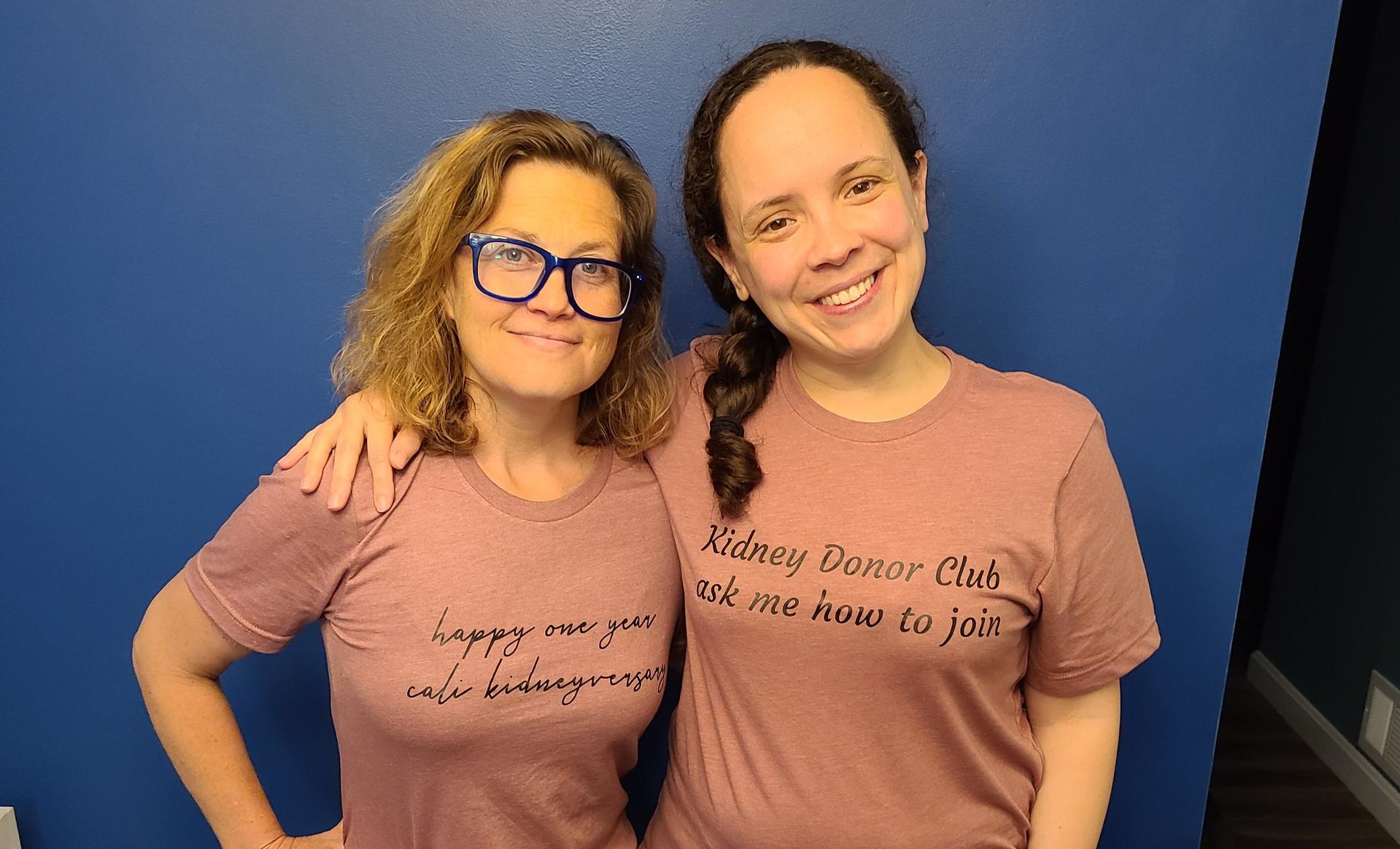
I want to take a moment to celebrate a personal celebration that emerged from connections made at the WRC. This month marks my one year anniversary of donating a kidney to this amazing woman, Amanda Minor. We met through a mutual friend (also connected to the WRC) and over the course of our friendship she joined the team of counselors at the WRC. When it became clear that she was in need of a kidney transplant, I readily agreed to complete the screening and many, many tests later was cleared. We weren’t a direct match, so we went through the National Kidney Registry and became part of a swap donation. Through the miracles of science (and coordination) Amanda now has a kidney from California and a school teacher in Virginia has one of mine. 

It was a humbling experience to realize that I could help a friend in this way. I believe that most people– faced with the reality of failing health of a dear friend or family member– would consider doing the same. We have decided to tell our story more publicly because living donation saves lives, and we think that more people might consider donation if they hear real stories of real people they may know personally.

Both Amanda and I are committed to equity, the transformative power of community, and ending domestic violence. Thanks to living organ donation, Amanda will be here– healthy and strong– to continue to fight for justice, educate future counselors, and support survivors of domestic violence.

In Solidarity,
Jessica Walsh
Executive Director

Link to July Newsletter

Take Action! Advocate for Domestic Violence supports @ your workplace

October is Domestic Violence Awareness Month, and each week we will be sharing one way you can take action to support those experiencing abuse in our community.

This week, we encourage you to advocate for domestic violence supports at your workplace. This email includes facts, suggested action steps, and links to resources to share with your human resources department or other decision-makers in your organization. 

COVID-19 continues to be a traumatic event for us all. Some workers face the impossible task of caretaking, or homeschooling, while trying to manage a 40-plus hour work week. At the same time, some workers are experiencing increased threats of violence in their homes. During this crisis, employers can play a key role in supporting survivors of domestic violence in their workforce. 

IMPACTS ON EMPLOYEES

One in four women experience domestic violence in their lifetime, and nearly 75% of survivors of domestic violence cite economic insecurity as the main reason they stayed with their abuser. We spend most of our waking hours at work, and yet most workplaces are not prepared to support employees who are experiencing domestic violence, sexual violence, and/or stalking.

Consider these facts:

  • 60% of survivors in one study reported losing their jobs as a result of domestic violence
  • 96% of survivors indicated that their job performance suffered as a result of the abuse
  • More than 50% of stalking victims report being stalked at work

IMPACTS ON WORKPLACES

In 2003, the Centers for Disease Control and Prevention estimated that domestic violence cost $8.3 billion dollars a year in direct health care costs and lost productivity. These issues hurt a business’ bottom line, and it’s in an employer’s best interest to proactively address them.

Consider these facts:

  • 24% of workplace violence is a related to interpersonal relationships, situations where an individual gains access to a workplace and commit a crime against an employee or customer who is a current or former intimate partner. 
  • 35% of Vermont domestic violence perpetrators surveyed had contacted their partners in an abusive manner during the workday and used work resources to do so, including work phones, work vehicles, work computers, internet, or email.

To learn more about how domestic violence impacts workplaces, check out this fact sheet.

TAKE ACTION: HOW YOU CAN HELP

Workplaces Respond to Domestic and Sexual Violence is a National Resource Center committed to creating workplaces free from domestic violence, sexual harassment and violence, and stalking. No matter what your role is at your workplace, you will find resources at Workplaces Respond to help you advocate for a work environment that is supportive to domestic violence victims and survivors.

Consider taking one of these action steps:

  1. Advocate for a domestic violence policy at your workplace. Share this model policy with your human resources department or other decision-makers in your organization.
  2. Encourage supervisors to watch this training video or review this guide. Supervisors can play a critical role in both preventing and appropriately responding to the impacts of domestic on the workplace. 
  3. Learn to recognize the signs of domestic violence in the workplace. If you suspect that an employee or co-worker is experiencing domestic violence, there are things you can do to help.
  4. Know the local resources available. The Women’s Resource Center provides services in Newport and Bristol Counties. Together, the members of the Rhode Island Coalition Against Domestic Violence serve the entire state of Rhode Island. 

Whether you are an employersurvivor or co-worker, or concerned specifically about supporting colleagues during the COVID-19 pandemic, there are resources available to help you create a more supportive work environment for victims of domestic violence.

HOW WILL YOU TAKE ACTION THIS WEEK?
Survivor Spotlight: Tanya’s Story

survivor_spotlight-JPEG
Tanya has had a long road. Her abuser forced her to leave their home, after a 13-year long marriage, with her daughter in the middle of the night. With nowhere to go and no resources, she called the Women’s Resource Center. From there, our staff took over, making sure the family was safe and connected with people who would help them. First, Tanya received safe shelter from our organization. When she was ready, both her and her daughter began seeing a counselor, completely free of cost. After several years of working with the Family Violence Option Advocacy Program, Tanya is feeling more empowered than ever.

She is mustering up the courage to file for divorce from her abuser, who she is still legally married too. “I no longer want to live in fear,” Tanya said when asked about her new goals. “I want to provide a safe and strong life for myself and my daughter.”

Survivor Spotlight: Janina’s Story

survivor_spotlight-JPEG

Janina was a victim of violence long before she was domestically abused.

She grew up in an abusive and traumatic household. As a child, her parents would use physical beatings as a way to discipline her and her younger sister. As is common with victims of violence, she unfortunately perpetuated this cycle of abuse as an adult, and chose an abusive partner.

Janina first came to the Women’s Resource Center to file a restraining order and was assisted by our Court Advocacy program.  The Advocates implemented a safety plan with Janina, encouraging her to move away from this cycle of abuse. They also worked with the sheriff’s department to ensure a quick service of the restraining order.

Despite the mental, physical and emotional hardships it took to leave her abuser, Janina did it, thanks to the Women’s Resource Center. After receiving our help, she was able to get full custody of her children and protection from her abuser, who had been in her life for over a decade.

Survivor Spotlight: Rita’s Story

survivor_spotlight-JPEG

The Women’s Resource Center was first contacted by Rita when her husband was arrested for domestic simple assault.

The Women’s Resource Center’s Court Advocate spoke at length with Rita about all available options, taking time to explain the court process in detail.  He also discussed possible dispositions for the case and advocated for her to prosecute against her abuser.

Rita was referred to our free counseling program, and began seeing a therapist regularly to deal with the emotional and physical trauma that her abuser had left her with.  Later, her case was “thrown out” and she gained protection from the court’s “no contact order.”  Despite this measure, Rita decided that enough was enough for her. She decided to file for divorce and end the cycle of abuse, which she had endured for so many years.

This is the power of the Women’s Resource Center, and a testament to the lives we touch with our programs every day.

Survivor Spotlight: Maura’s Story

survivor_spotlight-JPEGMaura was in a long-term abusive relationship.

As time went on, dependency on her partner increased as she relied on him for housing, food, money, and more.  Soon, the control escalated, and Maura became a victim of domestic violence.

One day, after an explosive argument, Maura felt his hands tightening around her neck. That was the final straw; she decided then and there she no longer would put up with her boyfriend’s emotional and physical abuse.

Before her courage escaped her, Maura called the police, and her partner was arrested. With assistance from Women’s Resource Center’s court advocacy program and crisis counseling, Maura was able to also testify against her former spouse. This lead to a conviction, sending him behind bars. After this harrowing series of incidents, Maura was able to reunite with her adult children and grandchildren from whom she had been estranged.

To date, with the help of the Women’s Resource Center, Maura has successfully obtained employment and continues to receive counseling services from the Center. She is happy to put the past behind her.


FEMpower: Panel & Breakfast Addressing Bullying in the Workplace Against Women

femPower_1-18

Long before the #MeToo movement and the Women’s March, bullying was an issue that started to gain traction in the workplace. From universities and boardrooms to offices and politics, it’s a form of intimidation and abuse and inherently similar to violence. Acknowledging how prevalent the abuse of power and control tactics are, particularly toward women, FEMpower was created with the goal of empowering women to deal with these situations in the workplace. Join us for a discussion about this topic and learn coping tactics and strategies to take back to your workplace. Men and women alike are invited to attend.

The breakfast and panel discussion will be held on Wednesday, February 21, 2018 from 7:30 am to 9:30 am at the Hope Club, 6 Benevolent St., Providence, RI. Tickets are $45.00, and proceeds support the Women’s Resource Center’s domestic violence prevention efforts and assistance for survivors.

Please RSVP by Monday, February 19, 2018 by calling 401-846-5263 or Register Online

Panelists include:
• Deb DeBare, Executive Director of the Rhode Island Coalition Against Domestic Violence (RICADV)
• Christine Cunneen, Chief Executive Officer of Hire Image, LLC
• Dr. Joan Johnson-Freese, Professor and former Chair of the National Security Affairs Department, U.S. Naval War College
• Emily Sack, professor at Roger Williams University School of Law

Featuring Betty Galligan, president of Newberry Public Relations & Marketing, Inc. and current president of the Hope Club, who will moderate the discussion.

Be sure to visit the FEMpower Facebook event and mark yourself as “Going” to share with your network! 

Survivor Spotlight: Trina’s Story

survivor_spotlight-JPEG

In the course of working with a victim of abuse, our staff often uncovers additional issues that need to be addressed.  Typically it is an underlying or hidden issue that is causing distress in the relationship.

Such was the case with Trina.  

The Women’s Resource Center’s Court Advocates reached out to her to discuss her pending criminal case. Trina openly spoke with the Court Advocate at length about her husband’s mental health issues, which had been negatively affecting their relationship, resulting in emotional and, sometimes, physical abuse.

The Advocate listened to what Trina had to say, resolving to help. Later, the Court Advocate spoke with attorneys for the prosecution to bring the mental health issues to light. Trina’s husband was ultimately referred to a program that ensured he went to mental health counseling. The case stayed open until Trina felt that her husband’s mental health was improving, which made her feel safe.

Trina and her husband eventually reconciled and were able to co-parent for their two children, resulting in a happier home than before thanks to the help of the Women’s Resource Center.

Survivor Spotlight: Harriet’s Story

survivor_spotlight-JPEG

Harriet contacted the Women’s Resource Center in need of financial help. She needed help organizing her finances and making smart choices for her family. The staff at the Women’s Resource Center assisted her with getting started with the Allstate Financial Empowerment training. 

The Allstate Foundation’s Moving Ahead Through Financial Management curriculum is a comprehensive package of tools and information designed to empower victims of domestic violence and abuse to be self-sufficient with their finances. The curriculum includes the following components:

  • Strategies for addressing the complex financial and safety challenges of ending a relationship with an abusive partner.
  • Information on how to protect personal and financial safety in an abusive relationship and after leaving an abusive relationship.
  • Methods for dealing with the misuse of financial records.
  • Tools to help people of all incomes and earning power work toward long-term financial empowerment, including budgeting tools, step-by-step planners and more.

After Harriet had been working on the Allstate Financial Empowerment training for a few months, she was encouraged to set goals for herself.  Her first goal was to save money for Christmas.  With strength and guidance, Harriet proudly managed to save enough money to give her children a bountiful Christmas without any help.

During the holiday months, the Women’s Resource Center runs an “Adopt-a-Family” program that provides detailed “wish lists” to generous people who want to purchase Christmas gifts for our clients. We had over 50 families “adopted” this year.  A staff member approached Harriet to ask if she would like her family to be “adopted” for this past holiday season. With a big grin, she answered, “Let someone needier be chosen. For the first time, I got this.”

Survivor Spotlight: Renee’s Story

survivor_spotlight-JPEG

Renee called Family Violence Option Advocacy Program for assistance from a RI hospital. She was recently displaced from her home. Her husband had physically assaulted her while she was pregnant and the police were called. Because it was evident that he assaulted her from her hysteria and slap redness marks on her face and wrists, he was arrested. Renee was sent to the hospital. Again, she was 4 months pregnant and told the police this information. She had another child but he was at that child’s father home during the incident. Because the home was owned by the husband, she had to find a place to live. Also, a no contact order was issued to him and he was released hence an immediate safety issue.

The hospital kept Renee and worked closely to assist her with finding housing before releasing her. During that assistance, the WRC was called and the call transferred to a Family Violence Option Advocacy Program staff. After the story was told, Family Violence Option Advocacy Program got off the phone and started making calls searching safe housing. Since it was very cold weather, it was a time when all shelters were completely full. However, after many calls, Lucy’s Hearth in Newport broke their entrance protocol for this special situation and found room for Renee with the agreement that the other child was able to remain with his father until she found permanent housing because there was only room for one person . She was released from the hospital and was taken by a social worker from there to meet Middletown Police at her home where she gathered her things and cab money was given by the hospital representative for her to go to Lucy’s Hearth.

When Renee was settled, Family Violence Option Advocacy Program met with her to assist her with all the resources she would need to apply for from the State. An intake for the Family Violence Option Advocacy Program was done. Renee remains a client and is successfully set up with all appropriate assistance. She is on the waiting list for Lucy’s Hearth transitional housing program which should only take about a month for her to transfer. She will then take her son back and continue to work with Family Violence Option Advocacy Program, WRC staff including court advocates , DHS, and Lucy’s Hearth and many other resources such as the RI Victims Compensation Program, FCCP, therapy and above adequate prenatal care.

Thanks to the Women’s Resource Center, Renee and her children are their way to a new beginning defeating and breaking this cycle of Domestic Violence in her life.