Category Archives: WRC in the News

March News & Updates

Dear Friends,

Happy Spring! Although I’ve been struggling more than is typical to adjust to the clocks changing this past week, I am enjoying the longer daylight hours and warming weather.

This month we have so many highlights that are focused on talking about domestic violence. In whatever context you find yourself, simply talking about the issue is something that everyone can do to help those experiencing violence in our community. Yet these conversations can be intimidating or uncomfortable– these 10 tips are super helpful if you want to help start the conversation in your workplace, faith community, book club, or neighborhood association.  

Conversations and Cocktails, happening this Thursday evening at the Lobster Pot, will be one opportunity to be part of this critical conversation. I hope you will come say hello!

In Solidarity,

Jessica Walsh

Executive Director

Continue reading March News & Updates from the Women’s Resource Center.

It’s time to take the next step!

When it comes to ending domestic violence, each step forward is a victory.  The Women’s Resource Center helps victims on their personal journeys to safety and works to create a healthy community for all. Every donation to the Women’s Resource Center brings us one step closer to ending domestic violence. Last year alone, your generous support made possible:

  • 8,297 support sessions with 1,296 clients
  • 2,143 hotline calls answered
  • 11,711 shelter and transitional housing nights

Please, if you have not already donated, take the next step and make your contribution today. The demand for our services is increasing. Federal and state funding is uncertain. These challenging times challenge us all to do more. Your gift will help ensure we are there for all. 

Help us end domestic violence one life at a time, one step and a time. And remember, if you need help, call us. We are here for you. 

Thank you!

In Solidarity,
Jessica Walsh
Executive Director

Donate safely online or mail your tax deductible contribution to:

Women’s Resource Center
114 Touro Street
Newport, RI 02840

Thank you for taking the step to help end domestic violence!


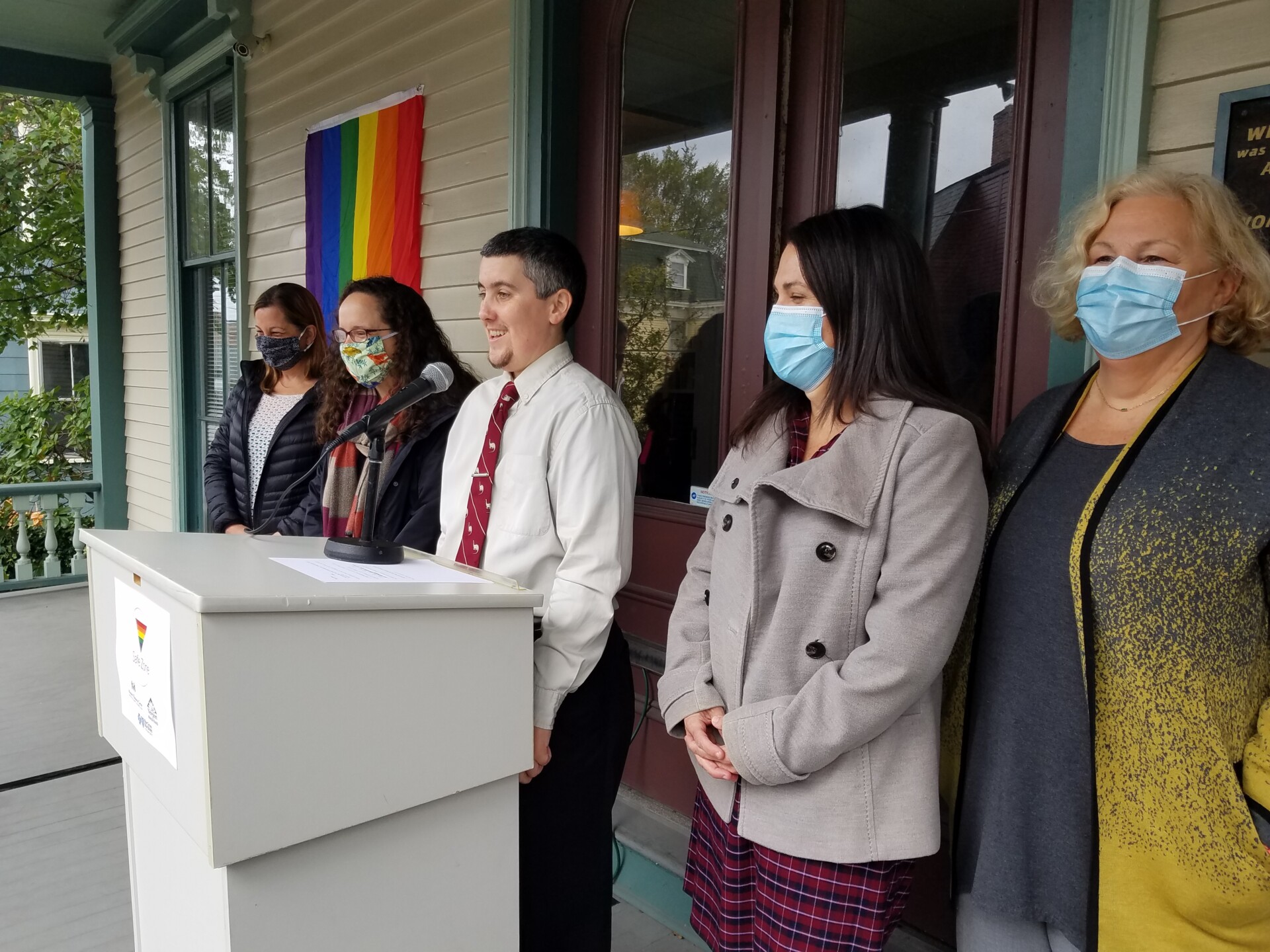
Women’s Resource Center and Newport Mental Health Certified as BCBSRI LGBTQ Safe Zones

NEWPORT, R.I. (October 28, 2021)   Newport Mental Health and Women’s Resource Center (WRC) have received designation as LGBTQ Safe Zones by Blue Cross & Blue Shield of Rhode Island (BCBSRI). These are the first two Newport County agencies to become part of the BCBSRI LGBTQ Safe Zone Program, which certifies providers and community-based organizations identifying themselves as supporters of the LGBTQ community.

“Every person deserves safe and healthy relationships,” WRC Executive Director Jessica Walsh said. “Domestic violence does not discriminate, and can impact anyone regardless of race, gender identity, sexual orientation, or social status – though the burden of domestic abuse is not shared equally. Domestic violence occurs in LGBTQ relationships at similar or higher rates than in heterosexual, cisgender relationships, and studies show gay men and bisexual women are at an increased risk for experiencing severe physical violence in intimate relationships.”

She continued, “At the Women’s Resource Center, we understand the critical need for trauma-informed support and affirming care for LGBTQIA+ survivors. All survivors deserve to be supported, believed and valued, especially those who face additional barriers including discrimination and differential treatment in their journey to safety and rebuilding their lives after abuse.”

“The Safe Zone certification goes far beyond gender neutral bathrooms, although that’s a good start,” said Newport Mental Health CEO and President Jamie Lehane. “Inclusion and equity are paramount, and we want to be sensitive and welcoming to all populations, cultures and ethnicities. For the Safe Zone Program, all of our staff, including receptionists, clinicians, finance and others, have undergone extensive training. We’ve modified our intake forms, emails, and other documentation. We want everyone who comes through our doors to know we are here for them and will do whatever it takes to help them in an affirming and positive way.”

BCBSRI launched its LGBTQ Safe Zone program in 2016. The program has now certified more than 40 Safe Zone providers in locations across Rhode Island representing a number of specialties, primary and dental health and behavioral health services. This program helps facilitate access to affirming care for this under-served community with specific healthcare needs, one that has historically struggled with healthcare interactions, and has often forgone necessary regular care due to feelings of alienation, stress, frustration and fear. Certified entities must meet a number of requirements reflecting policies, procedures, and physical space related to equity and inclusion for LGBTQ patients.

“Seeing the Safe Zone logo in the window helps members of the LGBTQ community know that they will receive culturally competent, inclusive and affirming care when they walk through that door,” said Carolyn Belisle, BCBSRI managing director of corporate social responsibility. “We applaud Newport Mental Health and Women’s Resource Center for their tremendous commitment.”

“The Newport Health Equity Zone’s LGBTQ+ Health working group is thrilled to see these two Island agencies take the huge strides to achieve the BCBSRI Safe Zone designation,” said Rex LeBeau, strategy specialist at the Health Equity Zone. “It’s a great first step in the commitment to serve LGBTQIA+ clients. We hope that now more local LGBTQIA+ people will receive the healthcare and support that they need and will feel like their community sees them, cares about them, and will continue to adopt affirming care practices.”

The Women’s Resource Center provides programs and services for domestic violence victims and their families, including counseling supports, shelter and housing services and court and family advocacy. The 24/7 statewide confidential Helpline can be reached at 1-800-494-8100, or via online chat at www.ricadv.org.

Newport Mental Health, a federally Certified Community Behavioral Health Clinic offers evidence-based mental health services to the 82,000 residents of Newport County, regardless of ability to pay. On an annual basis, NMH serves over 1,450 high risk adults and children at its five locations.

To learn more about the BCBSRI LGBTQ Safe Zone Program, find certified providers or for providers interested in certification requirements, visit bcbsri.com/providers/safezone-program.

For more information:
Contact Sandy Oxx, Newport Mental Health Communication Manager
soxx@newportmh.org 401-846-1213 ext. 139
or Becky Knight, office manager, Women’s Resource Center
rknight@wrcnbc.org, 401-236-8365

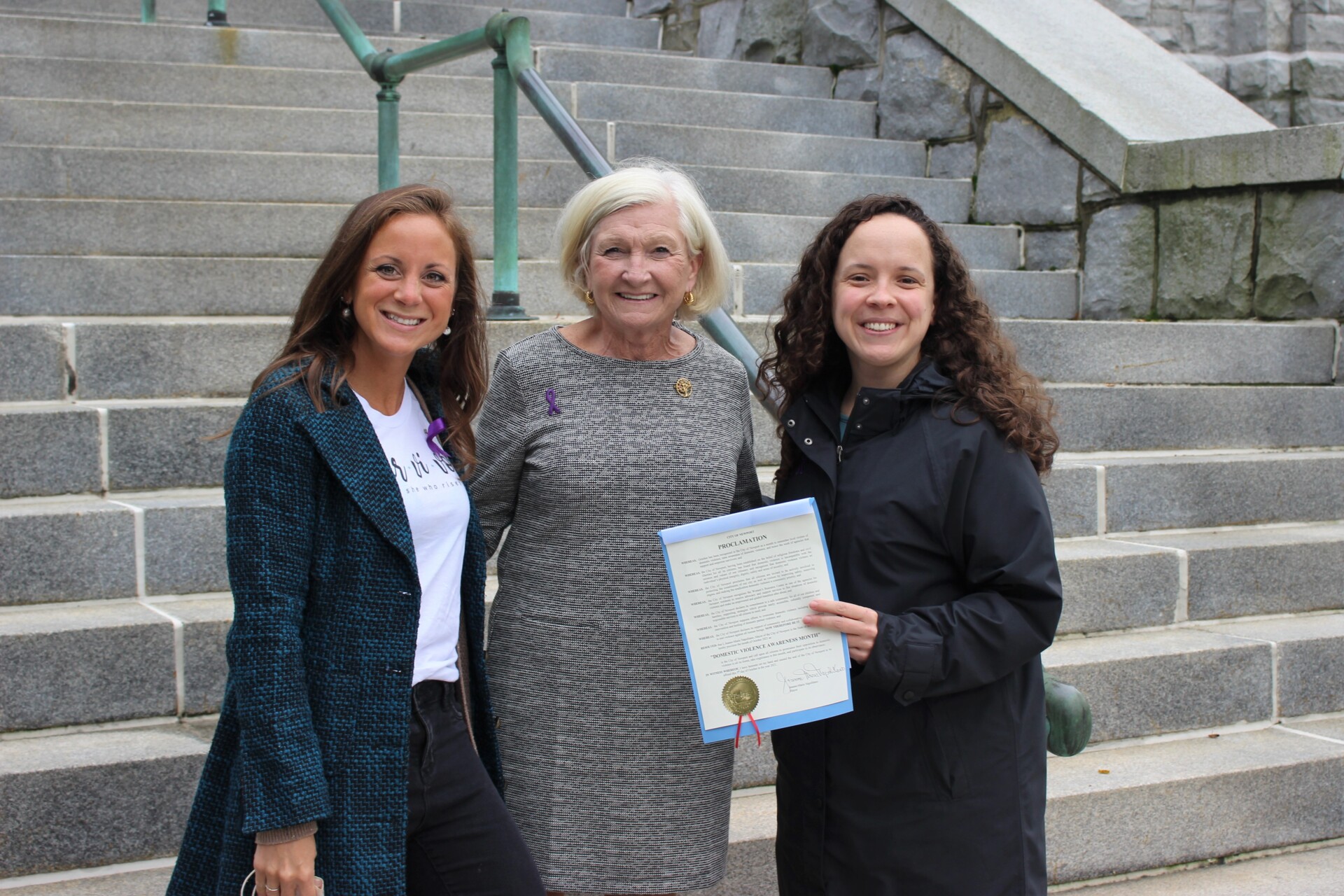
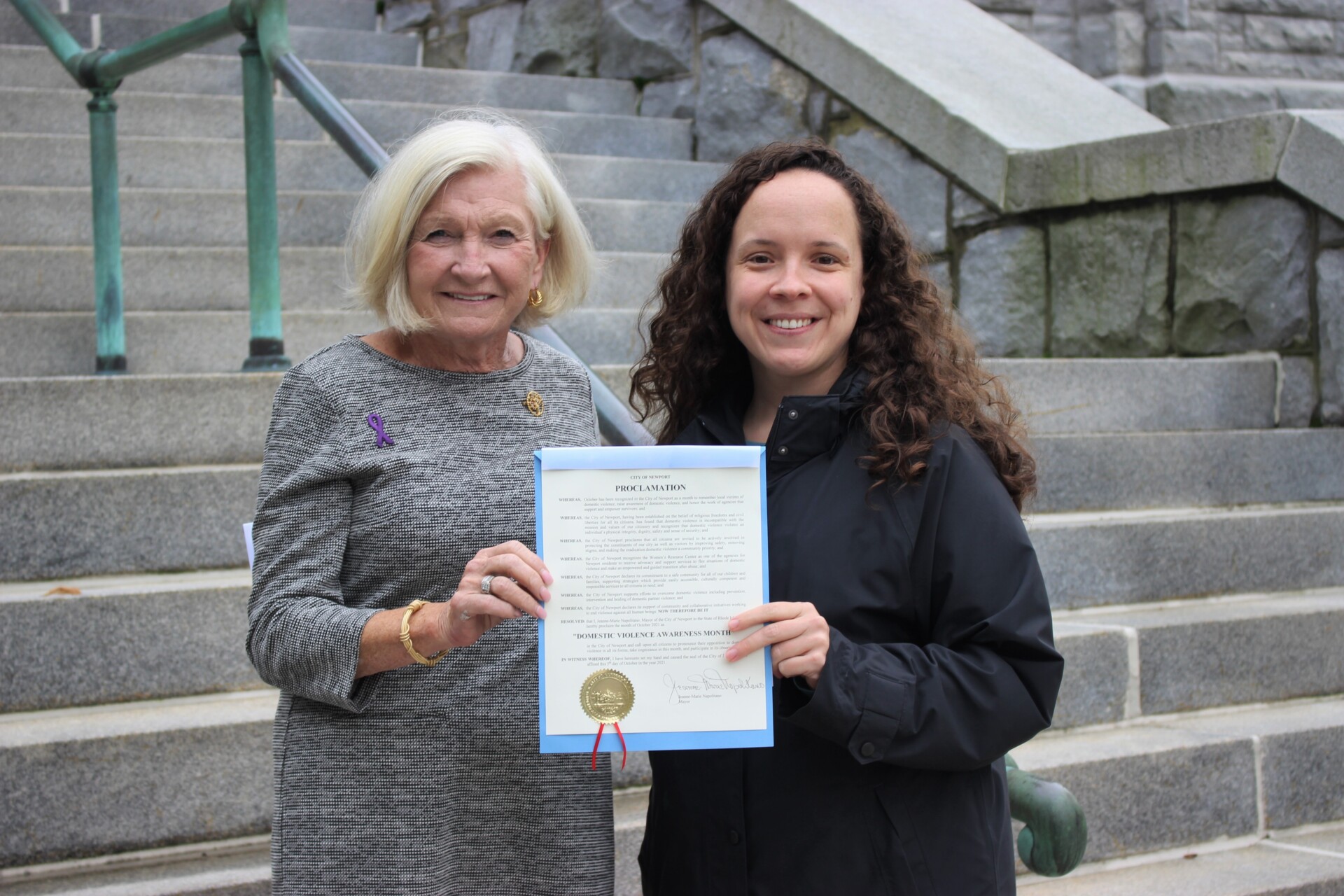
Mayor of Newport Officially Proclaims October as Domestic Violence Awareness Month

On Tuesday October 5, 2021, Newport Mayor Jeanne-Marie Napolitano proclaimed October as Domestic Violence Awareness Month. The proclamation was announced in partnership with the Women’s Resource Center (WRC) of Newport and Bristol counties. 

Delivered on the steps of City Hall, the proclamation included a brief speaking program that involved Mayor Napolitano as well as Jessica Walsh, executive director of the WRC, and Ashley Bendiksen, a survivor and WRC board member. 

“It’s important that people know that this issue exists,” Napolitano said, urging others to be aware in order to lend a hand to neighbors and children who may be exposed to harm.

In 2020, the WRC served nearly 1,300 individuals from Newport and Bristol counties, and saw a 25% increase in demand for services over the course of the year. In addition, the agency provided housing for twice as many individuals and answered 50% more hotline calls compared to 2019.

“This proclamation is sending a message loud and clear saying domestic violence will not be tolerated in Newport – that all of us, as neighbors and as a community, will come together to prevent domestic violence for future generations,” Walsh said.

Bendiksen, who shared her story as a survivor of domestic violence, outlined the impact of abuse on a person’s life. She expressed the need to increase awareness about the dynamics of abuse and support agencies serving survivors like the WRC. “They help survivors to rebuild the pieces of their life, and make the transition from victim to someone who can once again thrive,” Bendiksen said.

The official proclamation is a commitment to building a safe community, free from domestic violence. It honors the work of the WRC, and it calls upon all citizens to pronounce their opposition to domestic violence, be cognizant, and participate in the observance of Domestic Violence Awareness Month this October.

COVID-19 Update

June 25, 2021

Women’s Resource Center
Serving: Barrington, Warren, Bristol, Little Compton, Tiverton, Portsmouth, Middletown, East Providence, Newport and Jamestown.

  • Staff is communicating at this time via phone, text and video to continue to deliver core services and meet client needs.
  • We are holding phone and video conference meetings with managers, caseworkers, support staff, team members and board members to keep the lines of communication open and manage our operations.
  • Our website and social media platforms have the support and hotline phone numbers prominently displayed and communicated, and direct anyone in danger to call 911.
  • We are working with law enforcement and social services in our area to ensure our referral phone numbers and other ways to contact our key staff members are known.
  • We are monitoring the wellbeing of families living in our shelters to ensure their counseling and support needs are being met.
  • Our Newport office has resumed in-person services. Procedures are as follows:
    • Advocates are available 10 a.m. – 2 p.m. Monday through Friday, except for holidays.
    • We ask all drop-in and restraining order clients to call first to schedule an appointment so staff is able conduct a health screening prior to entering the office. Same day appointments are likely available. All appointments will be 45 minutes long to allow time afterward to clean and disinfect areas.
    • Our waiting areas are not open at this time. We require all visitors to wear face masks and utilize our hand sanitizer before entering the building. An advocate will direct you to our meeting room where there is a plexiglass shield for your safety.
    • If you do not feel comfortable entering the office, we have advocates available for resources, support and safety planning over the phone. Additionally, our advocates can assist with filling out restraining order paperwork over the phone. 

Current services being offered are:

  • Hotline: 401-846-5263 
  • Court advocacy
  • Law enforcement advocacy
  • Counseling
  • Support group
  • Shelter
  • Transitional housing
  • Family Violence Option Advocacy Program (FVOAP)
  • Prevention services

If you are unable to talk on the phone, email us at info@wrcnbc.org, or reach out using the Contact Us form on our website and someone will be in touch.

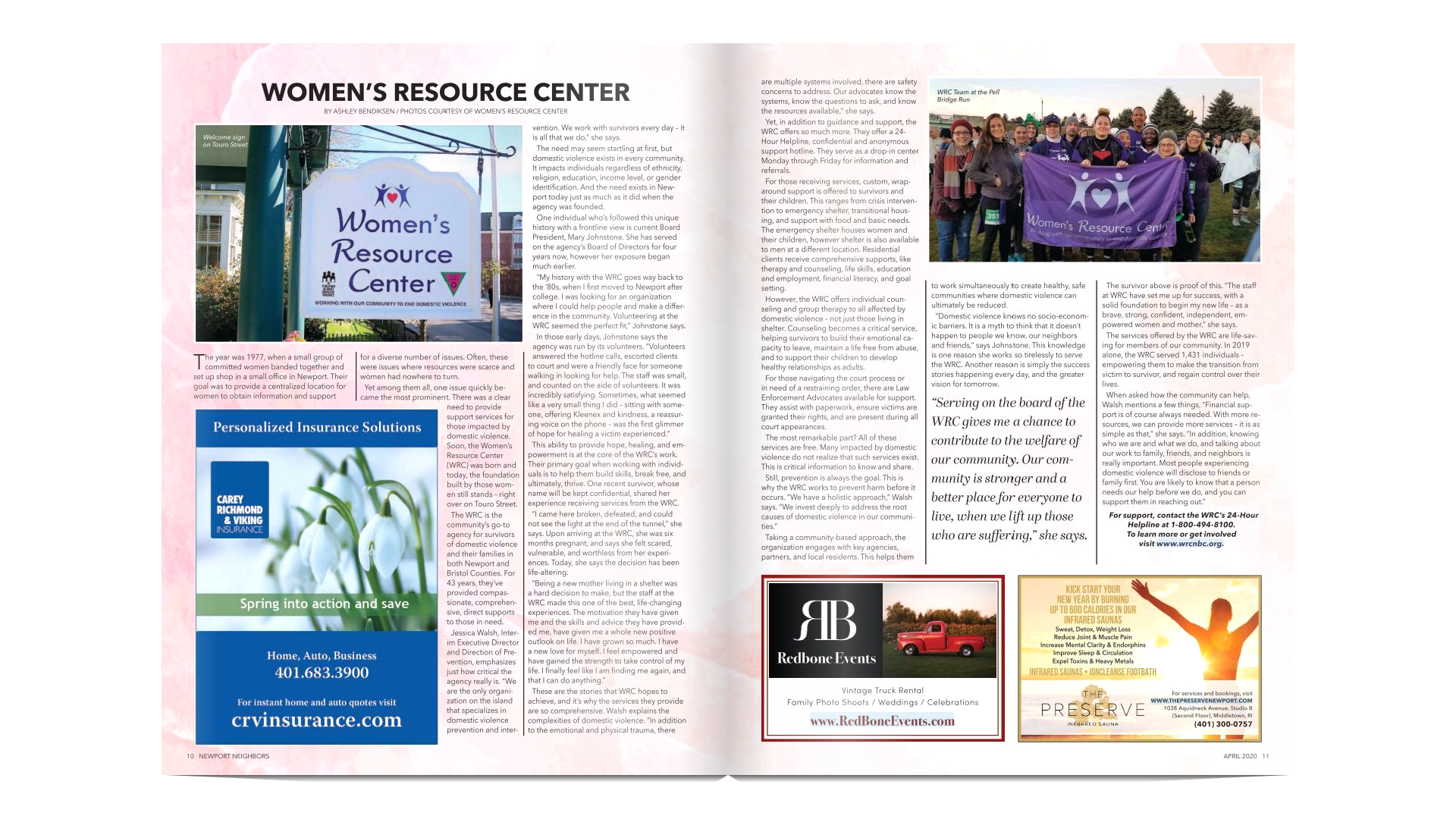
Women’s Resource Center – Newport Neighbors Magazine Feature

Original Source: Newport Neighbors Magazine, April 2020
By Ashley Bendiksen

The year was 1977, when a small group of committed women banded together and set up shop in a small office in Newport. Their goal was to provide a centralized location for women to obtain information and support for a diverse number of issues. Often, these were issues where resources were scarce and women had nowhere to turn.

Yet among them all, one issue quickly became the most prominent. There was a clear need to provide support services for those impacted by domestic violence. Soon, the Women’s Resource Center (WRC) was born and today, the foundation built by those women still stands – right over on Touro Street.

The WRC is the community’s go-to agency for survivors of domestic violence and their families in both Newport and Bristol Counties. For 43 years, they’ve provided compassionate, comprehensive, direct supports to those in need.

Jessica Walsh, Interim Executive Director and Direction of Prevention, emphasizes just how critical the agency really is. “We are the only organization on the island that specializes in domestic violence prevention and intervention. We work with survivors every day – it is all that we do,” she says.

The need may seem startling at first, but domestic violence exists in every community. It impacts individuals regardless of ethnicity, religion, education, income level, or sexual orientation. And the need exists in Newport today just as much as it did when the agency was founded.

One individual who’s followed this unique history with a frontline view is current Board President, Mary Johnstone. She has served on the agency’s Board of Directors for four years now, however her exposure began much earlier.

“My history with the WRC goes way back to the ‘80s, when I first moved to Newport after college. I was looking for an organization where I could help people and make a difference in the community. Volunteering at the WRC seemed the perfect fit,” Johnstone says.

In those early days, Johnstone says the agency was run by its volunteers. “Volunteers answered the hotline calls, escorted clients to court and were a friendly face for someone walking in looking for help. The staff was small, and counted on the aide of volunteers. It was incredibly satisfying. Sometimes, what seemed like a very small thing I did – sitting with someone, offering Kleenex and kindness, a reassuring voice on the phone – was the first glimmer of hope for healing a victim experienced.”

This ability to provide hope, healing, and empowerment is at the core of the WRC’s work. Their primary goal when working with individuals is to help them build skills, break free, and ultimately, thrive. One recent survivor, whose name will be kept confidential, shared her experience receiving services from the WRC.

“I came here broken, defeated, and could not see the light at the end of the tunnel,” she says. Upon arriving at the WRC, she was six months pregnant, and says she felt scared, vulnerable, and worthless from her experiences. Today, she says the decision has been life-altering.

“Being a new mother living in a shelter was a hard decision to make, but the staff at the WRC made this one of the best, life-changing experiences. The motivation they have given me and the skills and advice they have provided me, have given me a whole new positive outlook on life. I have grown so much. I have a new love for myself. I feel empowered and have gained the strength to take control of my life. I finally feel like I am finding me again, and that I can do anything.”

These are the stories that WRC hopes to achieve, and it’s why the services they provide are so comprehensive. Walsh explains the complexities of domestic violence. “In addition to the emotional and physical trauma, there are multiple systems involved, there are safety concerns to address. Our advocates know the systems, know the questions to ask, and know the resources available,” she says.

Yet, in addition to guidance and support, the WRC offers so much more. They offer a 24-Hour Helpline, confidential and anonymous support hotline. They serve as a drop-in center Monday through Friday for information and referrals.

For those receiving services, custom, wrap-around support is offered to survivors and their children. This ranges from crisis intervention to emergency shelter, transitional housing, and support with food and basic needs. The emergency shelter houses women and their children, however shelter is also available to men at a different location. Residential clients receive comprehensive supports, like therapy and counseling, life skills, education and employment, financial literacy, and goal setting.

However, the WRC offers individual counseling and group therapy to all affected by domestic violence – not just those living in shelter. Counseling becomes a critical service, helping survivors to build their emotional capacity to leave, maintain a life free from abuse, and to support their children to develop healthy relationships as adults.

For those navigating the court process or in need of a restraining order, there are Law Enforcement Advocates available for support. They assist with paperwork, ensure victims are granted their rights, and are present during all court appearances.

The most remarkable part? All of these are free. Many impacted by domestic violence do not realize that such services exist. This is critical information to know and share.

Still, prevention is always the goal. This is why the WRC works to prevent harm before it occurs. “We have a holistic approach,” Walsh says. “We invest deeply to address the root causes of domestic violence in our communities.”

Taking a community-based approach, the organization engages with key agencies, partners, and local residents. This helps them to work simultaneously to create healthy, safe communities where domestic violence can ultimately be reduced.

“Domestic violence knows no socio-economic barriers. It is a myth to think that it doesn’t happen to people we know, our neighbors and friends,” says Johnstone. This knowledge is one reason she works so tirelessly to serve the WRC. Another reason is simply the success stories happening every day, and the greater vision for tomorrow.

“Serving on the board of the WRC gives me a chance to contribute to the welfare of our community. Our community is stronger and a better place for everyone to live, when we lift up those who are suffering,” she says.

The survivor above is proof of this. “The staff at WRC have set me up for success, with a solid foundation to begin my new life – as a brave, strong, confident, independent, empowered women and mother,” she says.

The services offered by the WRC are life-saving for members of our community. In 2019 alone, the WRC served 1,431 individuals – empowering them to make the transition from victim to survivor, and regain control over their lives.

When asked how the community can help, Walsh mentions a few things, “Financial support is of course always needed. With more resources, we can provide more services – it is as simple as that,” she says. “In addition, knowing who we are and what we do, and talking about our work to family, friends, and neighbors is really important. Most people experiencing domestic violence will disclose to friends or family first. You are likely to know that a person needs our help before we do, and you can support them in reaching out.”

For support, contact the WRC’s 24-Hour Helpline at 1-800-494-8100. To learn more, get involved, or donate, visit www.wrcnbc.org. You can also support the WRC by attending their signature Butterfly Ball gala on Saturday April 25th at the Newport Beach House. Full details in our events calendar.

On behalf of the WRC, thank you to Newport Neighbors Magazine for this recognition! We encourage all to find them online and follow their publication.

COVID-19 Crisis: No Person Left Behind

Message from the Interim Executive Director

March 17, 2020

Dear Friends:

The COVID-19 coronavirus pandemic has hit home locally, and the Women’s Resource Center has responded by transitioning to remote services, effective yesterday.

This means that staff in our Newport and Warren offices are working remotely from home in an effort to stem the spread of the virus to other staff members, their families, clients and the broader community.

Health concerns are our top priority, as is ensuring those affected by domestic violence can continue to get the help they need.

Rest assured, we remain available to support anyone experiencing domestic violence in our communities throughout Bristol and Newport Counties.

It’s a critical time because we want no person left behind when it comes to dealing with intimate partner violence.

  • Staff is communicating at this time via phone, text and video to continue to deliver core services and meet client needs.
  • We are holding phone and video conference meetings with managers, case workers, support staff, team members, and board members to keep the lines of communication open and manage our operations.
  • Anyone visiting our office locations in Newport or Warren will be directed via signage to call our Domestic Violence Crisis Support and Shelter Hotline phone numbers.
  • Our website and social media platforms have the support and hotline phone numbers prominently displayed and communicated, and direct anyone in danger to call 9-1-1.
  • We are working with law enforcement and social services in our area to ensure that our referral phone numbers and other ways to contact our key staff are known.
  • We are monitoring the well-being of families living in our shelters to ensure their counseling and support needs are being met.

As this is a stressful time for all, it can also be a time for increased situational intimate partner violence to occur. Now more than ever, people and families seeking our help will need someone to talk to, a safe haven to turn for assistance and sheltering, and the very best in counseling services that we can provide.

Some of our sources of funding and support have been disrupted, ie. our annual fundraiser has had to get postponed. Please consider helping us continue our important and critical mission and meet the demand for our services. Even a small amount can help us to provide:

  • Counseling
  • Advocacy
  • Law Enforcement Liaison Work
  • Shelter Program
  • Hotline Call Staffing
  • And More

Your donation – in whatever amount – is much appreciated by us and those we serve.

Thank you for your continued support of WRCNBC.

In solidarity,

Jessica Walsh
Interim Executive Director

Eyes on the prize: 2018 health equity summit draws 750

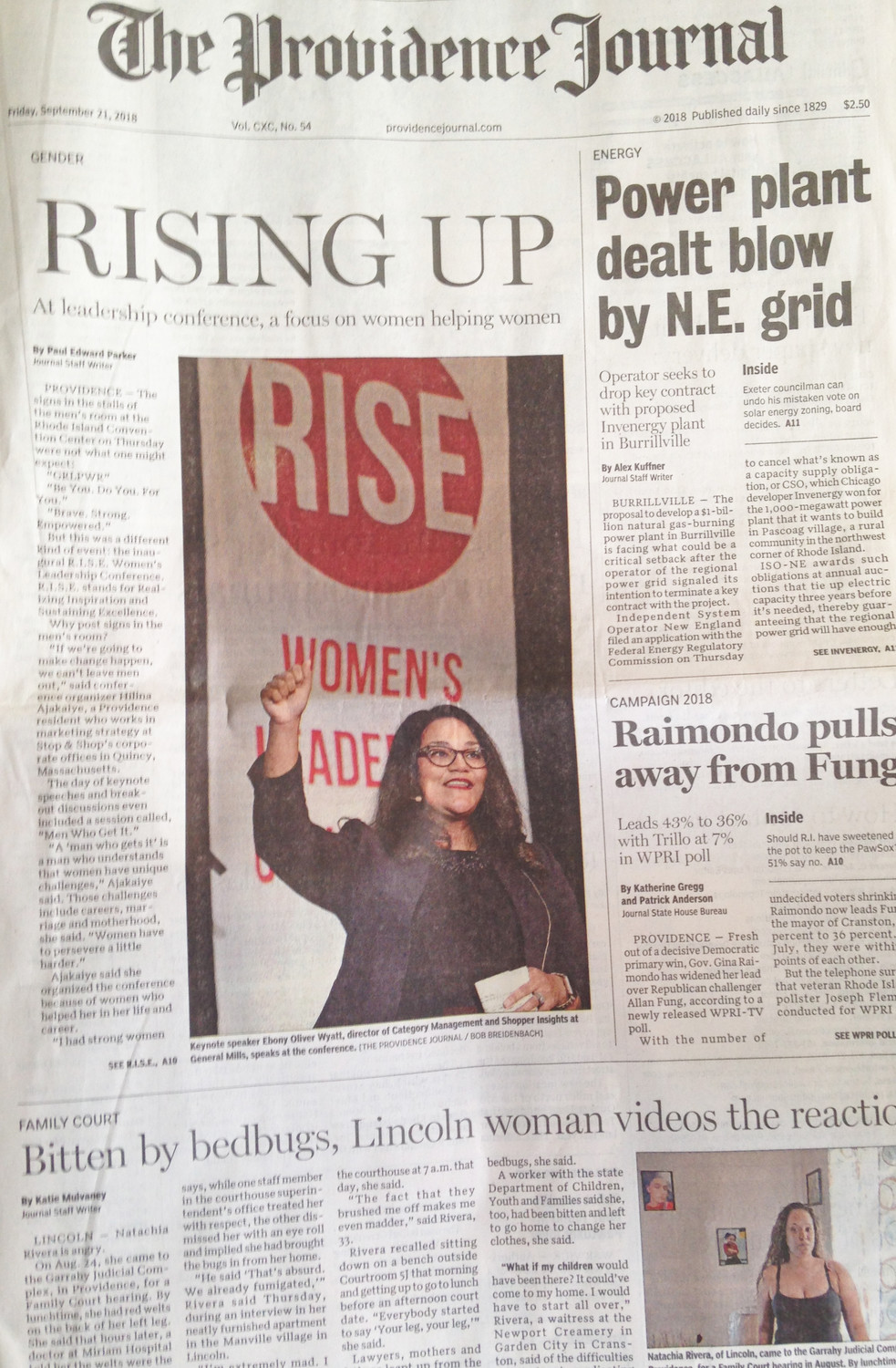
The front page of the Sept. 21 edition of The Providence Journal, which covered one event happening the day before on the fifth floor of the Providence Convention Center, but not the 2018 Health Equity Summit, which drew more people.PROVIDENCE – What does a news silo look like? The hardened boundary resulting in some events being reported while others are ignored? The visual image of an editorial wall built around those preferred narratives that are covered and promoted?

More often than not, the actual boundaries of a news silo can be hard to discern, similar to difficulties in recognizing the lasting stigma carried by survivors from unreported sexual assaults.

Not last week.

Despite the best efforts of the Republican majority in the Senate to tamp down the revelations about the alleged attempted rape committed by Supreme Court nominee Brett Kavanaugh against a university professor and research psychologist from California when they were both teenagers, the story has overflowed the riverbanks – and the swirling waters have kept rising.

Too many women know the relative truth from their own personal experiences with being sexual assaulted to be swayed by patronizing white male Republican Senators, such as Orrin Hatch, that somehow Christine Blasey Ford was “confused” or “mixed up.”

News silos in action
Closer to home, all one had to do was glimpse the front page of The Providence Journal on Friday, Sept. 21, to witness a news silo in action.

The big front-page, above-the-fold news feature story and photo, with the all caps headline, “RISING UP,” reported on the women’s leadership conference, Realizing Inspiration and Sustaining Excellence, on the fifth floor of the Providence Convention Center, which drew a crowd of about 500 participants, according to the Journal story.

The impressive event was certainly newsworthy of being covered, of being placed on the front page, of sending a photographer to capture images of what happened at a conference, which focused on community building and empowerment of women in the workplace and entrepreneurship, from a workplace perspective.

But, what was missing? What was being ignored? What was not being reported on? The glaring fact was that right next door, a short football toss away on the fifth floor of the Providence Convention Center, the third annual Health Equity Summit was taking place, drawing an even larger crowd of more than 750 participants.

The 2018 Health Equity Summit, “Building Healthy and Resilient Communities,” celebrated the belief that everyone in Rhode Island should have access to live the healthiest life in the healthiest community, according to Dr. Nicole Alexander-Scott, the director of the R.I. Department of Health, in her opening remarks.

Alexander-Scott and the keynote speaker, Dr. Edward P. Ehlinger, framed the context of the work around health equity by the numbers: life expectancy is dropping in the U.S., the rate of infant mortality and maternal is increasing, and the reality that only 10 percent of health outcomes are determined by what happens in a doctor’s or nurse’s office, despite trillions upon trillions of dollars spent on medical care.

The solution: to shift investment into places where health begins – in our homes, schools, jobs and communities.

Ehlinger, who called himself a public health metaphysician, spoke about the underlying malaise – the lack of a sense of belonging and the lack of social cohesion and the need for connectedness.

The summit highlighted the work of nine operating health equity zones in Rhode Island, which places the state as the national leader in promoting community-based solutions to health, social and economic disparities. [For those news outlets that like to cover lists about where the state ranks nationally, Rhode Island is number-one in the U.S. in health equity zones.]

In the unlikely case that any of the moderators [Ted Nesi, Tim White] of the first debate between the 2018 gubernatorial candidates on Thursday, Sept. 27, were to ask a question about health equity zones, where they are located geographically, and what they seek to achieve, here are the answers [none of which can be found in The Providence Journal].

The nine HEZs in Rhode Island include: a citywide Providence HEZ, a citywide Pawtucket and Central Falls HEZ; a citywide Newport HEZ, an Olneyville Neighborhood HEZ in Providence; an Southside, Elmwood and West End Neighborhood HEZ in Providence; a countywide Washington County HEZ; a citywide West Warwick HEZ; a citywide Woonsocket HEZ; and a townwide Bristol HEZ.

Each HEZ has its own focus, based upon a community needs assessment, to achieve health equity by eliminating health disparities by using place-based, where-you-live strategies to promote healthy communities.

The inclusive summit featured more than 50 concurrent workshops and breakout sessions, with the goal of building a shared language around community health, tackling complex, difficult topics, including: Improving neighborhood health through the built environment; supporting families with substance-exposed newborns; healthy aging and why it matters; outcomes-based funding for health equity interventions; development without displacement; and addressing disparities in cancer care among Latinos in Rhode Island.

Before launching into an in-depth coverage of the 2018 Health Equity Summit, here are some “impertinent” questions, in the best tradition of Studs Terkel, for Providence Journal Executive Editor Alan Rosenberg to answer:

What prevented The Providence Journal reporter and photographer from crossing the artificial boundary between the two events? [It did not stop some of the participants, who were speakers at both conferences.] Was it a lack of curiosity? Was it the constraint of the assignment? Given the recent layoffs, were there not enough reporters on hand to cover both stories? Not enough freelancers? Was it because the RISE conference had numerous large corporate sponsors, such as Shop & Stop, Care New England, Lifespan, and Blue Cross and Blue Shield of Rhode Island, Amica, Bank Rhode Island, Bank Newport, Bank America, and Cox, among others? Was it an existential choice, choosing corporations over communities, the business of health care over healthy communities?

Was it an endorsement of the status quo, as Robert Frost once posed in his poem, “Mending Wall,” about his neighbor, whom he described as moving “in darkness, as it seems to me, not of woods only and the shade of trees,” an enduring belief in the idea that “good fences make good neighbors?”

I’m writing as fast as I can
There was so much content and conversation occurring all at the same time, and so much valuable information being shared at the 2018 Health Equity Summit, it was difficult to figure out how best to the tell the story.

Here are some snapshots:

At the breakout session, “How Housing Works To Support Health,” which highlighted the importance of housing stability in bolstering healthy outcomes, Karen Santilli, the president of Crossroads RI, Tanja Kubas-Meyer, the executive director of the R.I. Coalition for Children and Families, Jody Shue, executive director of Age Friendly RI, and Dr. Michael Fine, the senior population health and clinical services officer at Blackstone Valley Community Health Care, discussed the lack of affordable housing options as a health disparity issue.

Shue pointed out the demographic problem – that Rhode Island was the number-one state in the nation with the highest number of “old old” residents, people who were 85 years and older, and that 14-20 percent have mental health issues. In turn, Shue described a pilot program at Charlesgate providing clinical services for residents. Phase Two of the program is scheduled to begin shortly, which will include a full-time behavioral health specialist.

Santilli spoke about the yearning, even among the homeless population that Crossroads serves, for a sense of community, wanting to live in the places where they have social networks.

Fine talked about what he called the battle rhythm of housing first, primary care second, to help lives become more coherent.

When moderator Brenda Clement, the director of Housing Works RI, posed the question about investments and resources needed to change the current dynamic, Fine replied: On one level, it was about redirecting the unnecessary amounts of money being spent on health care. The larger issue, Fine continued, was that the coordination between housing and health was “nobody’s job,” identifying the problem that too much of the work was being done in silos. “It’s nobody’s job,” Fine repeated.

• The collisions of people and ideas, that concept often articulated as a valuable part of the innovation ecosystem, kept occurring at the summit. ConvergenceRI first bumped into Dr. Patricia Flanagan, professor and vice-chair of the Pediatrics at the Warren Alpert Medical School, chief of Clinical Affairs at Hasbro Children’s Hospital, and co-chair of PCHM-Kids, a statewide, multi-payer initiative that includes 20 practices and serves nearly half the children in Rhode Island. The point of convergence: the importance of story telling in the delivery of health care.

• The next moment of serendipity came minutes later, when Colleen Daley Ndoye, the executive director of Project Weber/RENEW, called out to ConvergenceRI to say hello. Her community agency, a peer-based harm reduction and recovery services program for at-risk people in Rhode Island, had just been awarded a $2.5 million, five-year federal grant from SAMHSA [the Substance Abuse, Mental Health Services Administration], in partnership with The Miriam Hospital and the R.I. Public Health Institute, to focus on substance abuse treatment for high-risk HIV negative Rhode Islanders, focusing on Black and Latino men who have sex with men.

When had the grant been announced? ConvergenceRI asked. “It’s being announced today,” Daley Ndoye said; it is embargoed until 1 p.m., she added, looking at her watch. “Then you can write about it.”

Project Weber/RENEW has been one of the recovery community groups engaging with folks with fentanyl test strips, and ConvergenceRI asked her the importance of the new harm reduction tool in her agency’s work.

“Fentanyl test strips are such a unique and useful resource,” Daley Ndoye explained. “They can be the moment that someone decides to take charge of their own life. They can decide, at that moment, to say: I want to live; I want to see what is in these drugs; I want to educate myself.

Maybe they are not ready to stop using drugs, Daley Ndoye continued. “But maybe that moment of education, that moment of awareness, is a sign that that they are willing to start making small changes. Once you’re willing to start make small changes, that can snowball, so you can start making bigger changes in your life.”

The importance of access to fentanyl test strips, Daley Ndoye concluded, was the way in which the harm reduction tool could change the equation. “Somebody who decides to test their drugs for fentanyl might not be will to stop using, but they might use less, they might use slower, they are at lower risk for an overdose, and then they might consider, in six months time, getting into recovery, and that’s a big victory for us.”

Daley Ndoye also weighed in on the experience of trauma from sexual assault and sexual violence. “The way we talk with our clients, and the way our clients talk with us, they describe trauma as this,” she said. It leaves an imprint on your psyche, on your person, on who you are, and everything that you do moving forward is affected by that initial trauma, where it is in childhood, as a teenager, or as an adult.”

Every day in her work, she continued, “In dealing with people who are victims of trauma, and who are survivors of trauma, and with our staff, who are all trauma survivors, I think the lesson is this: things are not always logical, things don’t always make sense, it’s not always one plus one equals two.”

Things will come out years later, she said, as a person goes through the healing process. “We talk to people for years, and then, years later, they say, ‘This happened to me.’”

Keeping the health in health equity
A strong evidenced-based argument was put forward by the team at Clinica Esperanza/Hope Clinic that in order to achieve health equity, the needs of everyone in the community, even those left behind by the current system, must be met.

In a breakout session entitled “The ‘Health’ in Health Equity: How a clinic for immigrants significantly improves health outcomes through access to care and health education,” the team from the community health clinic serving Olneyville in Providence provided the evidence and outcomes to back up their position.

Clinica Esperanza Hope Clinic serves more than 2,000 patients a year, mainly Central and South American immigrants, 60 percent of whom speak Spanish as their primary language and 75 percent of whom report household incomes of less than $15,000 a year.

The focus of much of the culturally appropriate care delivered is on nutrition education, cholesterol/blood pressure/glucose checks, primary care and vaccinations. Through what is known as the “Bridging The Gap” program, which includes quarterly visits with primary care provider and participation in a health education program, patients’ use of emergency departments was reduced significantly compared with Medicaid patients.

One of the goals of the program is to manage chronic diseases before they become emergent or incurable, improving the quality of life and lessening the burden on local hospitals and ERs to provide charity care.

After the session, ConvergenceRI spoke with Dr. Annie De Groot, the founder and volunteer medical director at Clínica Esperanza, who spoke forcefully about the need to include health access as part of the process of achieving health equity.

“I still think we have a real problem with under-insurance and un-insurance in our communities,” she said. “If people don’t know they have diabetes, they are not going to get on a bike, or walk on a trail that everyone is building, or go to yoga classes. They just won’t know that it is very important to them.”

De Groot believes that access to primary health care can really make a difference in peoples’ lives. “Let’s not turn our backs on that.”

One of the strengths of the 2018 Health Equity Summit was that some of the underlying tensions around how scarce resources were being invested could be talked about.

De Groot, for instance, candidly told ConvergenceRI that relationship between Clinica Esperanza and ONE Neighborhood Builders is “fraught with tension” right now because of the spending of money on activities that are not related to connecting people to actual health care.

“People think that the problem [of access to health care] was fixed with Obamacare,” De Groot said. “Just like, with HIV, because now you can get treatment for HIV, we don’t have an HIV problem. Well, hello, yes we do. And, we still have a health care problem, especially for people living in Olneyville.”

Many people who are renting in Olneyville, De Groot continued, “They do not have access to health care.”

Clearly, it is a conversation, a discussion and dialogue that needs to be continued; but the differences are out in the open, and the 2018 Health Equity Summit provided an opportunity for everyone to be heard.

via convergenceri.com
Letter To The Editor: Will you help us light up the night?

October is domestic violence awareness month and as a board member of the Women’s Resource Center I wanted to ask the community to come together and join us for a night of light to honor all the victims of domestic violence.  It is sometimes hard to believe that domestic violence happens in our beautiful seaside town and that the services the center provides are so needed.  The Women’s Resource Center is a safe haven for women and families who are coping with domestic violence in all its forms.   It can be easy to say that domestic violence does not exist in our community if you don’t witness it yourself. But the statistics bear out that it does and it is getting worse.

Domestic violence does not always start with physical violence and bruising. Derogatory language aimed at making a person feel small and without value is often how it begins. Around the world at least one in every three women has been beaten, coerced into sex or otherwise abused during her lifetime. In the US alone everyday more than three women are murdered by their husbands or boyfriends. Most think of domestic violence as a woman walking around with black eyes, broken bones or obvious bruises and they fail to see the woman who is yelled at every day and called horrible names, the woman who is threatened by violence and in fear that her children will be taken away, or the woman who has nowhere to go so she stays.

I want to change what victims and survivors see when they look at our Newport County Community.  I want them to see light and therefore I ask you to please join me on October 29, 2018 at 6:00 PM on the steps of the Women’s Resource Center (114 Touro St, Newport, RI) as we light 1 candle and pass that light to all that join us and together we walk to the Newport Courthouse in silence with our light.  I ask that you walk for the 1 out of 3 women who have been abused in her lifetime, I ask that you walk for the children and silent witnesses to a women’s suffering, I ask that you walk for the survivors of domestic violence who were able to get away and most importantly I ask you to walk for the women who feel afraid to come into the light.  Please join me and the board of the Women’s Resource Center to create such a bright light that all feel safe to come out of the darkness and know this community supports them.  Will you help us light up the night?

For more information on Women’s Resource Center please go to https://wrc.wndrwrk.com/.

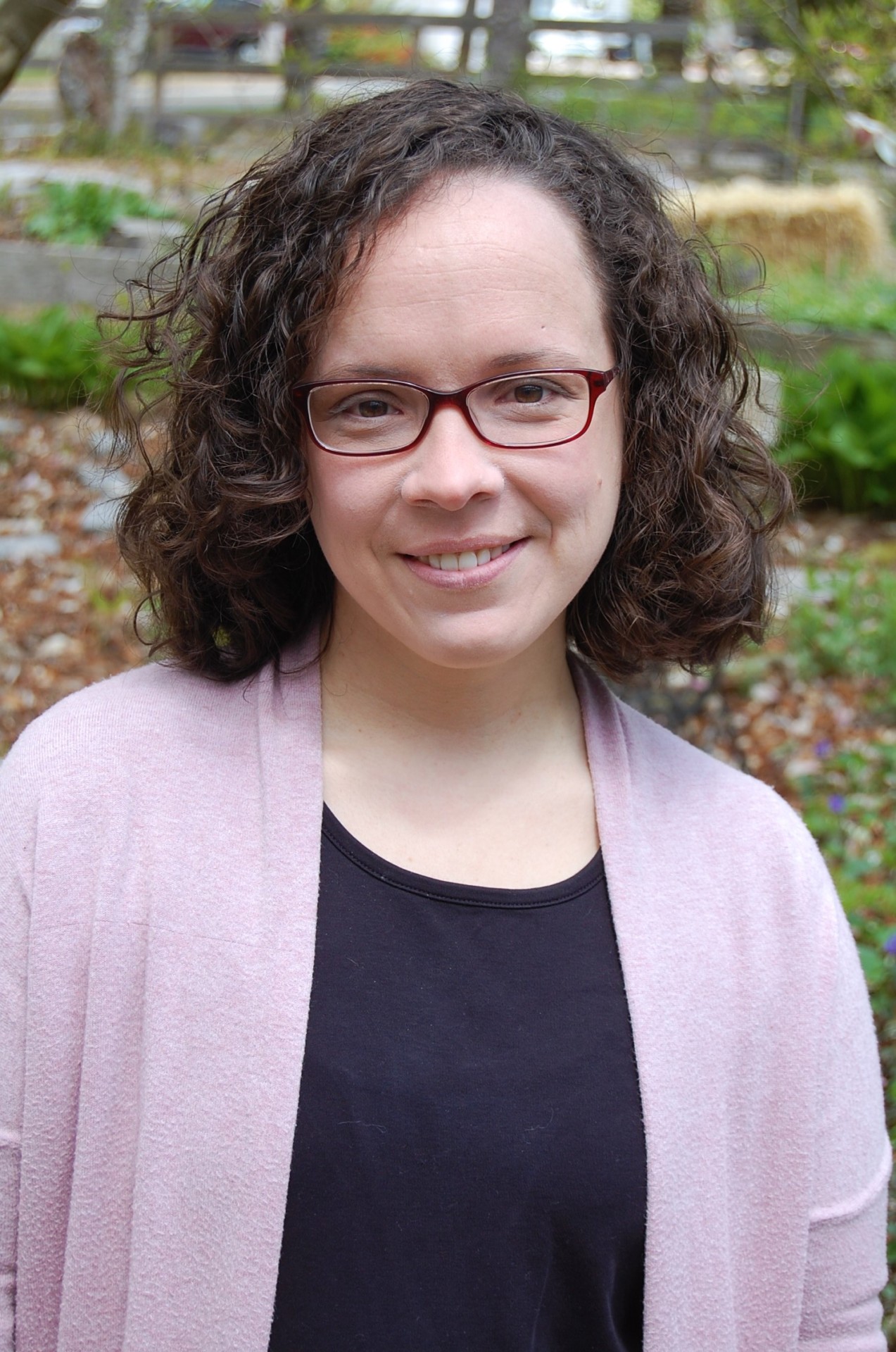
Eilish FitzGerald Clarkson

Board Member Women’s Resource Center

via whatsupnewp.com

Letter To The Editor: Domestic Violence & Gun Control

Letter To The Editor: Domestic Violence & Gun Control

By Lori N. DiPersio, executive director, Women’s Resource Center serving Newport and Bristol counties

Last month, Governor Raimondo signed legislation to keep guns away from domestic abusers. As Rep. Teresa Tanzi stated, “At last, victims of domestic abuse in Rhode Island will not have the constant fear of knowing that the person who abused them still has a gun.”

As if the abuse itself is not enough to cause constant, paralyzing fear, adding guns to the mix is like adding fuel onto a fire. Abused women are five times more likely to be killed by their abuser if the abuser owns a firearm. It’s a simple fact that guns in the hands of any person with a history of violence can only lead to tragedy.

Case in point is the recent Texas church massacre. The gunman was convicted and jailed for assaulting his wife repeatedly and beating his infant stepson until he suffered a fractured skull. He spent time in a mental institution, was booted from the military for bad conduct, stalked and harassed ex-girlfriends and was sentenced for animal cruelty for beating a puppy. His long resume of violence dates back to middle school.

Despite all of these warning signs and a well-documented dark past for such a young person, he was able to amass a gun collection that he used to kill dozens of innocent souls – including those of a pregnant woman, her unborn child and numerous children. If you knew what you now know about this shooter, would you have in good conscience had any part in selling him a gun? If he could beat up a puppy and an infant with his bare hands, what would he have done with a gun in his possession?

Unfortunately, we – and the 26 dead, the numerous injured, their families and our grieving nation – know the answer.

It’s time we stop putting guns into the hands of those who cannot handle themselves. Support gun legislation to stop the violence and protect innocent lives, before it happens again.

Lori N. DiPersio, executive director, Women’s Resource Center

via Patch.com