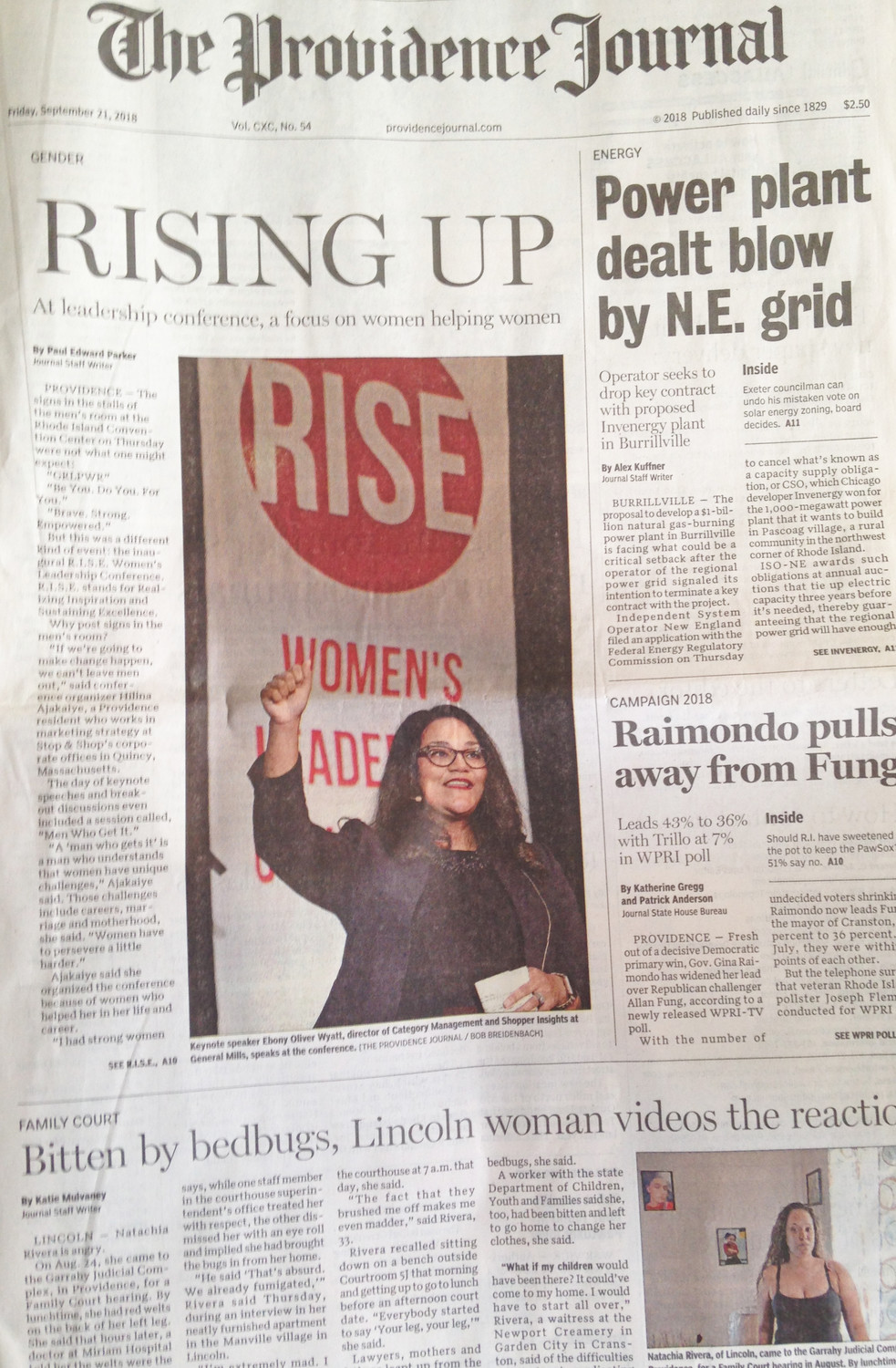
 PROVIDENCE – What does a news silo look like? The hardened boundary resulting in some events being reported while others are ignored? The visual image of an editorial wall built around those preferred narratives that are covered and promoted?
More often than not, the actual boundaries of a news silo can be hard to discern, similar to difficulties in recognizing the lasting stigma carried by survivors from unreported sexual assaults.
Not last week.
Despite the best efforts of the Republican majority in the Senate to tamp down the revelations about the alleged attempted rape committed by Supreme Court nominee Brett Kavanaugh against a university professor and research psychologist from California when they were both teenagers, the story has overflowed the riverbanks – and the swirling waters have kept rising.
Too many women know the relative truth from their own personal experiences with being sexual assaulted to be swayed by patronizing white male Republican Senators, such as Orrin Hatch, that somehow Christine Blasey Ford was “confused” or “mixed up.”
News silos in action
Closer to home, all one had to do was glimpse the front page of The Providence Journal on Friday, Sept. 21, to witness a news silo in action.
The big front-page, above-the-fold news feature story and photo, with the all caps headline, “RISING UP,” reported on the women’s leadership conference, Realizing Inspiration and Sustaining Excellence, on the fifth floor of the Providence Convention Center, which drew a crowd of about 500 participants, according to the Journal story.
The impressive event was certainly newsworthy of being covered, of being placed on the front page, of sending a photographer to capture images of what happened at a conference, which focused on community building and empowerment of women in the workplace and entrepreneurship, from a workplace perspective.
But, what was missing? What was being ignored? What was not being reported on? The glaring fact was that right next door, a short football toss away on the fifth floor of the Providence Convention Center, the third annual Health Equity Summit was taking place, drawing an even larger crowd of more than 750 participants.
The 2018 Health Equity Summit, “Building Healthy and Resilient Communities,” celebrated the belief that everyone in Rhode Island should have access to live the healthiest life in the healthiest community, according to Dr. Nicole Alexander-Scott, the director of the R.I. Department of Health, in her opening remarks.
Alexander-Scott and the keynote speaker, Dr. Edward P. Ehlinger, framed the context of the work around health equity by the numbers: life expectancy is dropping in the U.S., the rate of infant mortality and maternal is increasing, and the reality that only 10 percent of health outcomes are determined by what happens in a doctor’s or nurse’s office, despite trillions upon trillions of dollars spent on medical care.
The solution: to shift investment into places where health begins – in our homes, schools, jobs and communities.
Ehlinger, who called himself a public health metaphysician, spoke about the underlying malaise – the lack of a sense of belonging and the lack of social cohesion and the need for connectedness.
The summit highlighted the work of nine operating health equity zones in Rhode Island, which places the state as the national leader in promoting community-based solutions to health, social and economic disparities. [For those news outlets that like to cover lists about where the state ranks nationally, Rhode Island is number-one in the U.S. in health equity zones.]
In the unlikely case that any of the moderators [Ted Nesi, Tim White] of the first debate between the 2018 gubernatorial candidates on Thursday, Sept. 27, were to ask a question about health equity zones, where they are located geographically, and what they seek to achieve, here are the answers [none of which can be found in The Providence Journal].
The nine HEZs in Rhode Island include: a citywide Providence HEZ, a citywide Pawtucket and Central Falls HEZ; a citywide Newport HEZ, an Olneyville Neighborhood HEZ in Providence; an Southside, Elmwood and West End Neighborhood HEZ in Providence; a countywide Washington County HEZ; a citywide West Warwick HEZ; a citywide Woonsocket HEZ; and a townwide Bristol HEZ.
Each HEZ has its own focus, based upon a community needs assessment, to achieve health equity by eliminating health disparities by using place-based, where-you-live strategies to promote healthy communities.
The inclusive summit featured more than 50 concurrent workshops and breakout sessions, with the goal of building a shared language around community health, tackling complex, difficult topics, including: Improving neighborhood health through the built environment; supporting families with substance-exposed newborns; healthy aging and why it matters; outcomes-based funding for health equity interventions; development without displacement; and addressing disparities in cancer care among Latinos in Rhode Island.
Before launching into an in-depth coverage of the 2018 Health Equity Summit, here are some “impertinent” questions, in the best tradition of Studs Terkel, for Providence Journal Executive Editor Alan Rosenberg to answer:
What prevented The Providence Journal reporter and photographer from crossing the artificial boundary between the two events? [It did not stop some of the participants, who were speakers at both conferences.] Was it a lack of curiosity? Was it the constraint of the assignment? Given the recent layoffs, were there not enough reporters on hand to cover both stories? Not enough freelancers? Was it because the RISE conference had numerous large corporate sponsors, such as Shop & Stop, Care New England, Lifespan, and Blue Cross and Blue Shield of Rhode Island, Amica, Bank Rhode Island, Bank Newport, Bank America, and Cox, among others? Was it an existential choice, choosing corporations over communities, the business of health care over healthy communities?
Was it an endorsement of the status quo, as Robert Frost once posed in his poem, “Mending Wall,” about his neighbor, whom he described as moving “in darkness, as it seems to me, not of woods only and the shade of trees,” an enduring belief in the idea that “good fences make good neighbors?”
I’m writing as fast as I can
There was so much content and conversation occurring all at the same time, and so much valuable information being shared at the 2018 Health Equity Summit, it was difficult to figure out how best to the tell the story.
Here are some snapshots:
•At the breakout session, “How Housing Works To Support Health,” which highlighted the importance of housing stability in bolstering healthy outcomes, Karen Santilli, the president of Crossroads RI, Tanja Kubas-Meyer, the executive director of the R.I. Coalition for Children and Families, Jody Shue, executive director of Age Friendly RI, and Dr. Michael Fine, the senior population health and clinical services officer at Blackstone Valley Community Health Care, discussed the lack of affordable housing options as a health disparity issue.
Shue pointed out the demographic problem – that Rhode Island was the number-one state in the nation with the highest number of “old old” residents, people who were 85 years and older, and that 14-20 percent have mental health issues. In turn, Shue described a pilot program at Charlesgate providing clinical services for residents. Phase Two of the program is scheduled to begin shortly, which will include a full-time behavioral health specialist.
Santilli spoke about the yearning, even among the homeless population that Crossroads serves, for a sense of community, wanting to live in the places where they have social networks.
Fine talked about what he called the battle rhythm of housing first, primary care second, to help lives become more coherent.
When moderator Brenda Clement, the director of Housing Works RI, posed the question about investments and resources needed to change the current dynamic, Fine replied: On one level, it was about redirecting the unnecessary amounts of money being spent on health care. The larger issue, Fine continued, was that the coordination between housing and health was “nobody’s job,” identifying the problem that too much of the work was being done in silos. “It’s nobody’s job,” Fine repeated.
• The collisions of people and ideas, that concept often articulated as a valuable part of the innovation ecosystem, kept occurring at the summit. ConvergenceRI first bumped into Dr. Patricia Flanagan, professor and vice-chair of the Pediatrics at the Warren Alpert Medical School, chief of Clinical Affairs at Hasbro Children’s Hospital, and co-chair of PCHM-Kids, a statewide, multi-payer initiative that includes 20 practices and serves nearly half the children in Rhode Island. The point of convergence: the importance of story telling in the delivery of health care.
• The next moment of serendipity came minutes later, when Colleen Daley Ndoye, the executive director of Project Weber/RENEW, called out to ConvergenceRI to say hello. Her community agency, a peer-based harm reduction and recovery services program for at-risk people in Rhode Island, had just been awarded a $2.5 million, five-year federal grant from SAMHSA [the Substance Abuse, Mental Health Services Administration], in partnership with The Miriam Hospital and the R.I. Public Health Institute, to focus on substance abuse treatment for high-risk HIV negative Rhode Islanders, focusing on Black and Latino men who have sex with men.
When had the grant been announced? ConvergenceRI asked. “It’s being announced today,” Daley Ndoye said; it is embargoed until 1 p.m., she added, looking at her watch. “Then you can write about it.”
Project Weber/RENEW has been one of the recovery community groups engaging with folks with fentanyl test strips, and ConvergenceRI asked her the importance of the new harm reduction tool in her agency’s work.
“Fentanyl test strips are such a unique and useful resource,” Daley Ndoye explained. “They can be the moment that someone decides to take charge of their own life. They can decide, at that moment, to say: I want to live; I want to see what is in these drugs; I want to educate myself.
Maybe they are not ready to stop using drugs, Daley Ndoye continued. “But maybe that moment of education, that moment of awareness, is a sign that that they are willing to start making small changes. Once you’re willing to start make small changes, that can snowball, so you can start making bigger changes in your life.”
The importance of access to fentanyl test strips, Daley Ndoye concluded, was the way in which the harm reduction tool could change the equation. “Somebody who decides to test their drugs for fentanyl might not be will to stop using, but they might use less, they might use slower, they are at lower risk for an overdose, and then they might consider, in six months time, getting into recovery, and that’s a big victory for us.”
Daley Ndoye also weighed in on the experience of trauma from sexual assault and sexual violence. “The way we talk with our clients, and the way our clients talk with us, they describe trauma as this,” she said. It leaves an imprint on your psyche, on your person, on who you are, and everything that you do moving forward is affected by that initial trauma, where it is in childhood, as a teenager, or as an adult.”
Every day in her work, she continued, “In dealing with people who are victims of trauma, and who are survivors of trauma, and with our staff, who are all trauma survivors, I think the lesson is this: things are not always logical, things don’t always make sense, it’s not always one plus one equals two.”
Things will come out years later, she said, as a person goes through the healing process. “We talk to people for years, and then, years later, they say, ‘This happened to me.’”
Keeping the health in health equity
A strong evidenced-based argument was put forward by the team at Clinica Esperanza/Hope Clinic that in order to achieve health equity, the needs of everyone in the community, even those left behind by the current system, must be met.
In a breakout session entitled “The ‘Health’ in Health Equity: How a clinic for immigrants significantly improves health outcomes through access to care and health education,” the team from the community health clinic serving Olneyville in Providence provided the evidence and outcomes to back up their position.
Clinica Esperanza Hope Clinic serves more than 2,000 patients a year, mainly Central and South American immigrants, 60 percent of whom speak Spanish as their primary language and 75 percent of whom report household incomes of less than $15,000 a year.
The focus of much of the culturally appropriate care delivered is on nutrition education, cholesterol/blood pressure/glucose checks, primary care and vaccinations. Through what is known as the “Bridging The Gap” program, which includes quarterly visits with primary care provider and participation in a health education program, patients’ use of emergency departments was reduced significantly compared with Medicaid patients.
One of the goals of the program is to manage chronic diseases before they become emergent or incurable, improving the quality of life and lessening the burden on local hospitals and ERs to provide charity care.
After the session, ConvergenceRI spoke with Dr. Annie De Groot, the founder and volunteer medical director at Clínica Esperanza, who spoke forcefully about the need to include health access as part of the process of achieving health equity.
“I still think we have a real problem with under-insurance and un-insurance in our communities,” she said. “If people don’t know they have diabetes, they are not going to get on a bike, or walk on a trail that everyone is building, or go to yoga classes. They just won’t know that it is very important to them.”
De Groot believes that access to primary health care can really make a difference in peoples’ lives. “Let’s not turn our backs on that.”
One of the strengths of the 2018 Health Equity Summit was that some of the underlying tensions around how scarce resources were being invested could be talked about.
De Groot, for instance, candidly told ConvergenceRI that relationship between Clinica Esperanza and ONE Neighborhood Builders is “fraught with tension” right now because of the spending of money on activities that are not related to connecting people to actual health care.
“People think that the problem [of access to health care] was fixed with Obamacare,” De Groot said. “Just like, with HIV, because now you can get treatment for HIV, we don’t have an HIV problem. Well, hello, yes we do. And, we still have a health care problem, especially for people living in Olneyville.”
Many people who are renting in Olneyville, De Groot continued, “They do not have access to health care.”
Clearly, it is a conversation, a discussion and dialogue that needs to be continued; but the differences are out in the open, and the 2018 Health Equity Summit provided an opportunity for everyone to be heard.
via convergenceri.com