Monthly Archives: June 2022

June News & Updates

Dear Friends,

June is a month of celebrations: Juneteenth, Pride, Graduations, Fathers’ Day. All are reminders, in their own way, of the need to bring an intersectional lens to our work.

Domestic violence knows no boundaries and impacts all demographics, but it impacts some groups differently. Our young people who are graduating this month are in the age group at the highest risk for experiencing intimate partner violence. Black, non-Hispanic teenagers are at an even higher risk than there white and Latino peers. LGBTQIA+ individuals are also at higher risk for relationship violence. All of these groups often face additional barriers to accessing the support that they need.

As we take this moment to celebrate, let’s take a moment to affirm our commitment to addressing the systemic barriers that put some groups at greater risk of domestic violence, and make it harder for those same folks to access the services and protections they need.

In Solidarity,

Jessica Walsh

Executive Director

Please share this newsletter with your network and ask them to subscribe to keep up on the latest news, events and developments.

Continue reading June News & Updates.

May News & Updates

Dear Friends,

This month we are highlighting some of our policy advocacy work. We are excited to share with you some of the concrete ways we are advocating at the city and state level for safer futures for survivors of domestic violence in our community.

Advocacy is at the core of what we do every single day– in fact, nearly all of our frontline staff have “advocate” in their job title. At the individual level, we advocate for clients within the various systems they must navigate on their journey to safety– the justice system, the housing system, social safety net programs and services– to ensure they get the supports they need. At the community level, as the backbone agency of the Newport Health Equity Zone, we advocate for changes that will make Newport a place where all people can thrive, especially survivors of domestic violence and their families. At the state level, we are part of the Rhode Island Coalition Against Domestic Violence and we collectively advocate for priorities that meet the needs of survivors throughout the state.

I hope you enjoy learning a bit more about our advocacy efforts, and if you would like to lend your voice to advocacy efforts that support survivors, check out the RICADV’s legislative priorities.

In Solidarity,

Jessica Walsh

Executive Director

Continue reading May News & Updates

Subscribe to keep up on the latest news, events and developments.

North End Zoning Amendments and Domestic Violence Prevention

by Jean Riesman, Strategy Specialist, Newport Health Equity Zone

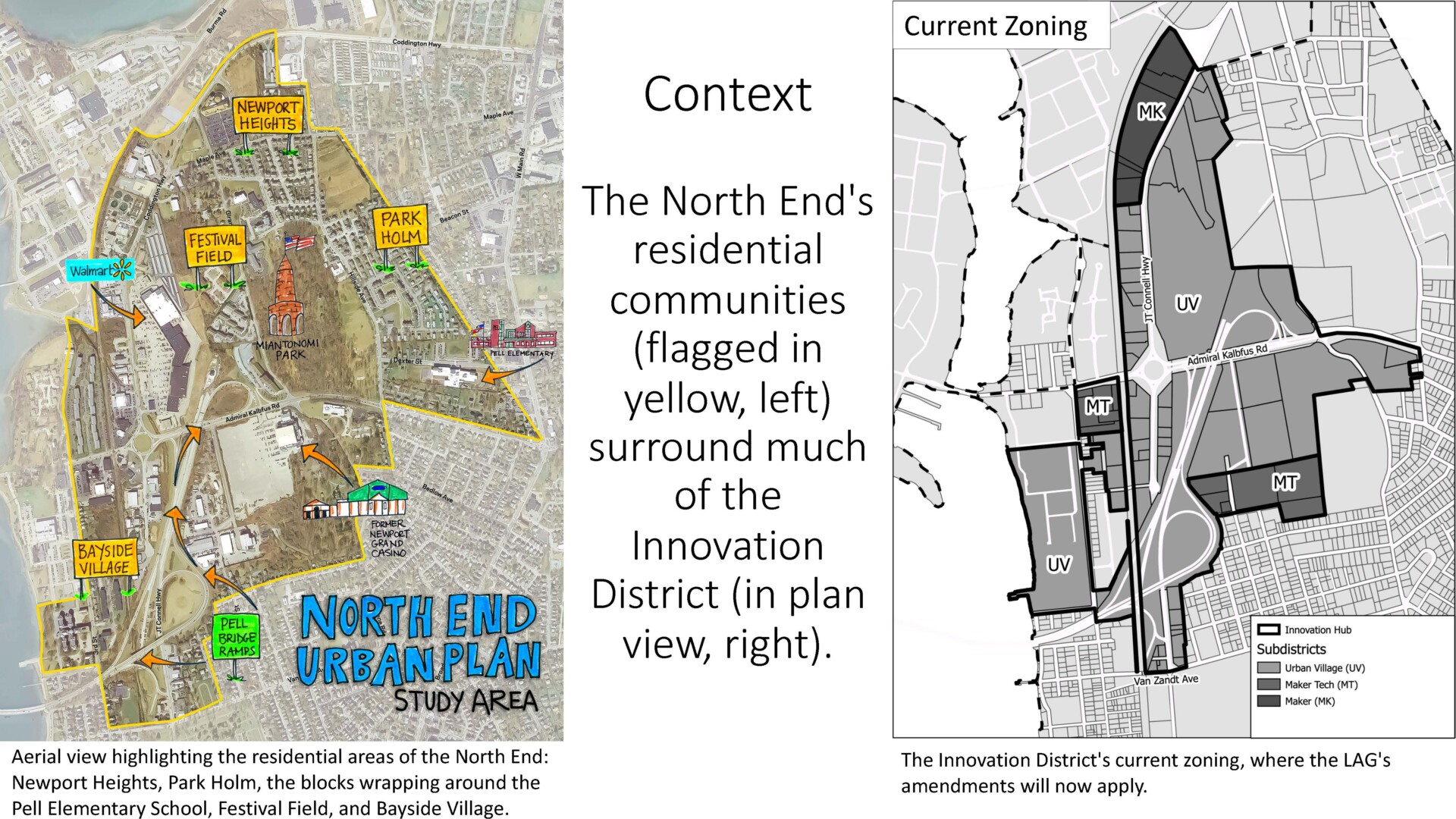
After a 10-month sprint to success, Newport Health Equity Zone (HEZ) residents recently won equitable amendments to the city’s zoning ordinance for its new Innovation District, a mixed-use 40+-acre technology hub adjacent to the North End neighborhood. With the HEZ’s support, the Local Advisory Group (LAG) pushed through three zoning amendments to spur workforce housing in large development projects, sharply define parks as well as civic and open space, and set the ground rules for community benefits agreements based on independent community-impact reports. The North End has been cut off from the rest of the city since the 1960s by the Pell Bridge’s elevated ramp structure; now that those ramps are coming down, much of the Innovation District will be built on that newly-valuable land. With the prospect of displacement and gentrification swamping the residential neighborhood, the Newport HEZ helped launch the LAG in 2021, recruiting Smart Growth America as consultant to convert resident priorities into an equitable-development strategy for the North End. Passed unanimously by the Newport City Council in on May 11, the zoning amendments were the first concrete policy change as a direct result of this process. 

This work crosses over into the Newport HEZ’s role as the Women’s Resource Center’s Prevention Department, by helping the community create conditions that will prevent domestic violence as well as providing pathways to independence. By incentivizing developers to build housing that is attainable for working families, the amendments will create more options for our neighbors who are survivors of domestic violence survivors seeking safety for their families. 

The amendments also clarify the types of green and open space in the required set-aside for major developments, focusing on usable, accessible spaces for the neighborhood – again, supporting the prevention of domestic violence in our community. Studies show that proximity to trees and parks is correlated with reduced rates of domestic violence, and the Centers for Disease Control and Prevention (CDC) highlights increasing access to green space as a promising community strategy for preventing domestic violence.